leica.jpg (74002 bytes)

Ireland

Education

Custom Search

Bookmark and Share


Study Physics at Trinity College Dublin Ireland


Trinity College, one of Europe's oldest and most respected universities, lies at the very heart of Ireland's capital city. Its historic buildings represent a famous tradition in both arts and science. Modern laboratories and research facilities now offer an inspiring environment for the study of physics, in a department that excels by international standards.


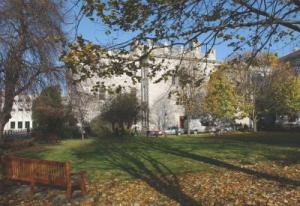
The FitzGerald Building, completed in 1906, still houses part of the Physics department.


Various undergraduate courses are offered in which physics is a major component. Each of these is a four year course, leading to an honours degree which is officially recognised by the Institute of Physics (the professional body for physics in the UK and Ireland.)
Theoretical Physics combines physics and mathematics in a demanding but rewarding programme, whose graduates are in strong demand by graduate schools in the US and elsewhere.
The main Physics Degree provides a good grounding in classical and modern physics, and includes an extensive research project in the final year. There is an Astrophysics option in the final two years.
Other courses are the degrees in Computational Physics and Physics and Chemistry of Advanced Materials.

Undergraduates enjoy a close relationship with staff of the Department. There are ample facilities for study, and students run their own Physical Society.

Graduate students are recruited from all over the world, and contribute to strong research programmes in materials science, nanotechnology, astronomy, information and communications technology, and computational physics. Together with our highly distinguished academic staff (three Fellows of the Royal Society), a large international community of postdoctoral fellows and our strong technical support staff, they form a lively intellectual community.


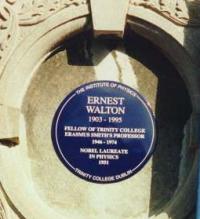
The Blue Plaque commemorating ETS Walton, Nobel Laureate in Physics 1951


Choose to study physics at Trinity, and enjoy life and learning in the university which has educated many great physicists in the past - Hamilton famous for quaternions and for his formulation of Newton's mechanics, FitzGerald of the FitzgGerald-Lorentz contraction in Relativity theory, Walton who with Cockcroft 'split the atom', and many others. Trinity published what is claimed to be the first physics textbook for    undergraduates (in 1739) but  is 'bang up-to-date'  with the  latest exciting developments in  the subject, and is networked into European research throughout the continent. 


For more information about the Department and our courses, visit our web page, http://www.tcd.ie/Physics/, or email physics@tcd.ie with "International student" in the subject line, for general information  about the university, see the Trinity College home page, http://www.tcd.ie/, and 'for information about how to apply for our undergraduate courses go to the Trinity College http://www.tcd.ie/ISA/dc/dcdegreeadmission.html International Student Affairs page


Office of International Student Affairs,
East Theatre,
Trinity College,
Dublin 2,
Ireland.

Tel: +353-1-608 3150
+353-1-608 2011
+353-1-608 2683
Fax: +353-1-677 1698
Email: ISA.Office@tcd.ie

Website


Trinity College Dublin

Office of International Student Affairs,
East Theatre,
Trinity College,
Dublin 2,
Ireland.

Tel: +353-1-608 3150
+353-1-608 2011
+353-1-608 2683
Fax: +353-1-677 1698
Email:
ISA.Office@tcd.ie

Website


n in vocational education & improvement of education and training pathways (Clair Andersen)

- the nature and development of the languages of Northern Australia (Ian Green)

- housing needs of young and elderly Tasmanian Aborigines, public policy and attitudes to Aborigines in 1990s & Aboriginal families (Maggie Walter)

- non material cultural appropriation and the colonization of cultures & Aboriginal autobiography and life-stories (Mitchell Rolls)

- Australian identity, family history, colonial and Aboriginal history (Shayne Breen)

- Indigenous knowledges and environment, identity and place in Tasmania (Greg Lehman)

- personal and national memory and representation in visual arts & archaeology, museums and collection (Julie Gough)

- construction and representation of Aboriginality in the Australian print media (Carol Pybus)

- governmentality, liberal arts schooling and Aboriginality (Terry Moore)

- historical biography (Walter, Gough & Lehman)

In recent years, with the development of an honours and postgraduate program, Riawunna has supported an exciting range of student research projects. Current projects include:

- spatial patterns in Aboriginal criminal justice (Lisa Rosevear)

- Aboriginal languages in Tasmania (John Taylor)

- public health policy effectiveness (Maggie Walter)

- Reconciliation (Kate Harrison)

- museums and Aborigines (Tony Brown)

- Aboriginal bushrangers and public remembering (Kali Ward)

- Aboriginal history of West Australia (Jennifer Sabbioni)

- Indigenous knowledge of weather and climate (Greg Lehman)


University of Tasmania

Contact:

Clair Andersen
Director, Indigenous Higher Education Programs
Riawunna, Centre for Aboriginal Education
University of Tasmania
Hobart, TAS 7001        Australia

ph    +61  03 6226 2517
fax   +61  03 6226 2575

E mail:

Clair.Andersen@utas.edu.au


Web:

fcms.its.utas.edu.au/arts/riawunna/